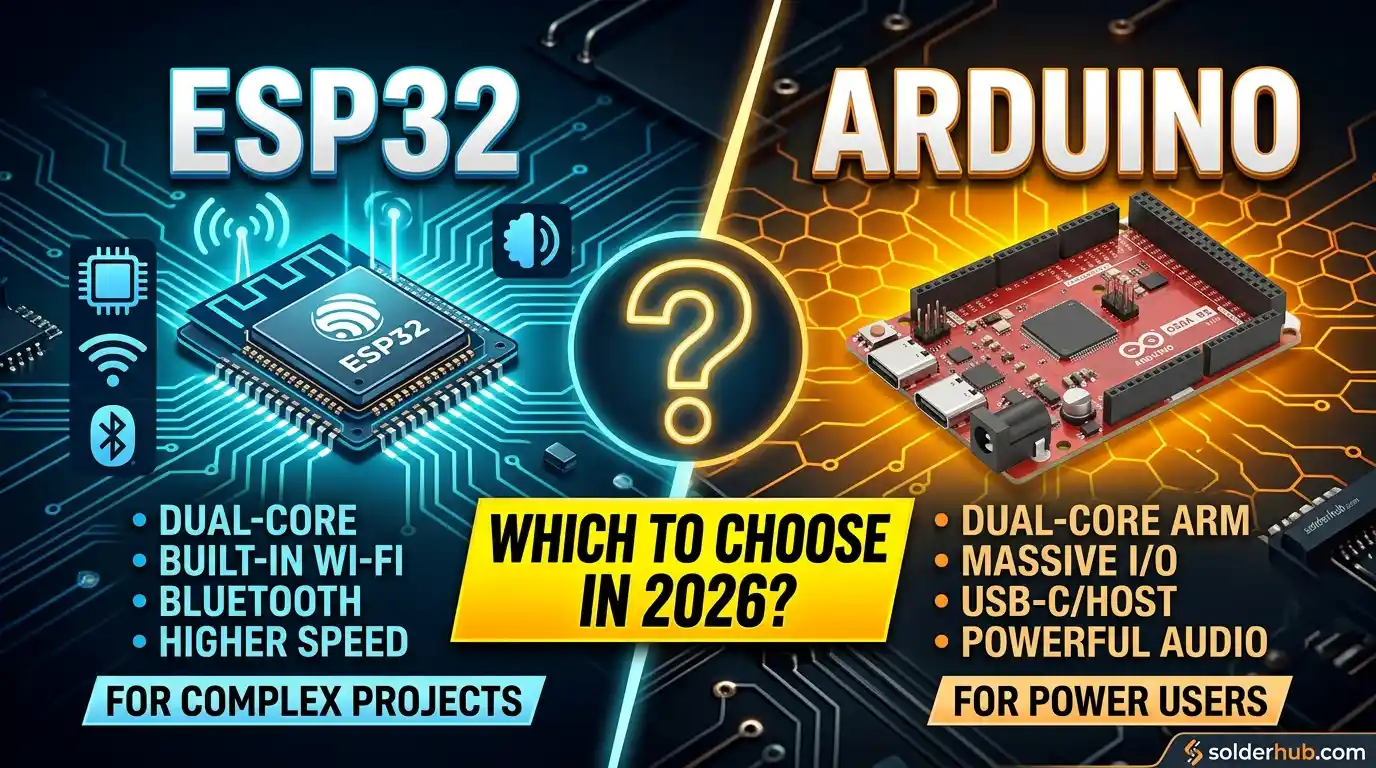
I get asked this question more than almost any other in the maker community, and honestly, it used to annoy me a little — because for years my answer was just "it depends," which is the most useless thing you can say to someone who's standing in front of two boards trying to decide which one to order. So let me actually do better than that here. By the end of this, you'll know exactly which board fits your situation, and more importantly, why.
If you've spent any time in Arduino subreddits, Discord servers, or maker forums, you've seen this debate play out a hundred times. Someone asks "ESP32 or Arduino for my project?" and the replies split into two camps almost instantly. One side says ESP32 is strictly better in every way and Arduino is obsolete. The other says Arduino is what real beginners should use and ESP32 is "too complicated." Both sides are partially right, and both are missing the actual point — which is that these two boards weren't built to compete with each other. They were built to solve different problems, and the moment you understand what problem each one solves, the choice usually makes itself.
[INSERT IMAGE HERE: Side-by-side photo of an Arduino Uno and an ESP32 DevKit board on a desk]
Why This Question Keeps Coming Up
Part of the reason this comparison refuses to die is that both boards occupy the same price bracket and the same general "hobbyist microcontroller" space, so on the surface they look interchangeable. You search for either one, and the same online stores, the same breadboard kits, and the same YouTube tutorials show up. New makers reasonably assume that means you pick whichever one looks shinier or has more views on its tutorial video.
But underneath that surface similarity, these are genuinely different pieces of hardware with different design philosophies baked in. Arduino's whole identity is built around the ATmega328P — a simple, slow, almost stubbornly basic 8-bit chip that has barely changed in over a decade. ESP32, on the other hand, is a dual-core, WiFi-and-Bluetooth-equipped beast that was originally designed for IoT products, not hobbyist education. They ended up in the same hobbyist ecosystem somewhat by accident — ESP32 got adopted by the maker community because it was absurdly cheap for what it offered, not because it was designed to replace Arduino.
Once you see them as tools built for different jobs rather than two competitors in the same race, the rest of this gets a lot easier to reason about.
The Actual Specs, Side by Side
Let's get the numbers out of the way first, because they matter more than people give them credit for.
Arduino Uno (ATmega328P)
- Clock speed: 16 MHz
- RAM: 2KB SRAM
- Flash storage: 32KB
- GPIO: 14 digital pins, 6 analog inputs
- Wireless connectivity: none built in
- Typical price: ₹400–600
ESP32 DevKit v1 (Xtensa LX6)
- Clock speed: 240 MHz, dual-core
- RAM: 520KB SRAM
- Flash storage: 4MB (typical)
- GPIO: 36 pins
- Wireless connectivity: WiFi 802.11 b/g/n plus Bluetooth 4.2/BLE
- Typical price: ₹350–500
[INSERT IMAGE HERE: Clean spec comparison table graphic, Arduino Uno vs ESP32 DevKit]
Look at that for a second. The ESP32 is roughly 15 times faster, has 260 times more RAM, comes with two CPU cores instead of one, ships with WiFi and Bluetooth built in — and it's often cheaper than the Arduino. On paper, this looks less like a comparison and more like a massacre. If you only looked at this table, you'd wonder why anyone still buys an Arduino at all.
And yet plenty of experienced makers, myself included, still reach for an Arduino on a regular basis. That's the part the spec sheet doesn't explain, and it's the part actually worth understanding.
Where Arduino Still Wins
Simplicity that protects beginners
The Arduino IDE is about as forgiving as a development environment gets. You write code, you hit upload, and within seconds you either see results or get an error message that's usually pretty easy to interpret. There's no wireless stack to configure, no partition tables, no boot mode pins to hold down at just the right moment during flashing. The mental model is dead simple: one program, running on one core, doing one thing at a time, in the order you wrote it.
This matters enormously for someone touching electronics for the first time. I've watched complete beginners wire something backwards, upload code with a typo, short a pin they shouldn't have — and the Uno just... survives. It's built around 5V logic with reasonably generous tolerances, and the whole ecosystem around it assumes you're going to make mistakes while learning. The ESP32 is comparatively delicate. Its GPIO pins run at 3.3V, a handful of pins are reserved for internal flash communication and will cause boot failures if you wire something to them without knowing better, and accidentally feeding 5V into the wrong pin can genuinely kill the board. None of this is a flaw in the ESP32's design — it's just a more "professional" piece of hardware that assumes you know what you're doing.
[INSERT IMAGE HERE: Beginner soldering or wiring an Arduino Uno on a breadboard]
Real-time, predictable timing
If your project lives or dies on precise timing — reading a rotary encoder without missing pulses, driving a stepper motor with exact step intervals, running interrupt-heavy code where jitter matters — the Arduino's single-core, no-operating-system simplicity is actually an advantage, not a limitation. There's nothing else competing for CPU cycles. No WiFi stack waking up in the background, no RTOS scheduler deciding which task gets priority this millisecond. What you write is, almost exactly, what executes, in the order you wrote it, with very few surprises.
The ESP32 runs FreeRTOS under the hood, and most of the time you don't notice it. But under genuinely time-critical loads, that extra layer can introduce small inconsistencies that wouldn't exist on a bare-metal AVR chip. For 95% of projects this never matters. For the remaining 5% — fast PID control loops, precise PWM generation, certain types of audio synthesis — it can matter quite a bit, and that's exactly the kind of project where I'd still reach for an Arduino, or sometimes a Teensy, over an ESP32.
Power efficiency, with an asterisk
An Arduino running a simple sensor loop on a coin cell battery, spending most of its time in deep sleep and waking briefly to take a reading, can genuinely last years on a single battery. This is part of why so many simple, battery-powered sensor projects — a mailbox notifier, a soil moisture alarm, a door sensor — still default to AVR-based boards.
The ESP32 can sleep impressively deep too — its deep sleep current draw is genuinely excellent on paper — but the complexity of managing that sleep cycle correctly, combined with the WiFi radio's appetite for power the moment it wakes up to transmit anything, makes power budgeting a noticeably harder problem to get right. It's absolutely achievable — there are ESP32 projects running for a year off a single battery — but it takes more careful firmware design to get there. With an Arduino, low power often just falls out of the design almost by default, simply because there's so little drawing current in the first place.
[INSERT IMAGE HERE: Battery-powered Arduino sensor project, coin cell visible]
Where ESP32 Wins, Decisively
Anything that needs to talk to the outside world
This is the big one, and it's not close. The moment your project needs to send data anywhere — to your phone, to a cloud dashboard, to another device on the network, to a smart home hub — the ESP32 is simply the right tool. WiFi and Bluetooth are already on the chip. You're not adding a shield, not managing a second piece of hardware, not burning through your budget on an add-on module that often ends up costing more than the ESP32 itself would have. You just... call the WiFi library and connect.
I genuinely can't remember the last time I recommended adding a WiFi shield to an Arduino Uno for a new project. It used to be common advice years ago. Today it almost never makes sense — by the time you've bought the shield, dealt with its quirks, and accepted the extra wiring complexity, you've spent more money and more frustration than just starting with an ESP32 in the first place.
[INSERT IMAGE HERE: ESP32 connected to WiFi, phone showing a dashboard receiving sensor data]
Raw processing power
Running an FFT on incoming audio to detect frequencies, decoding and processing camera frames from an ESP32-CAM module, handling HTTPS requests with proper TLS encryption — none of this is remotely possible on an Arduino Uno's 2KB of RAM. It's not a question of "harder" — it's a question of "the chip physically cannot hold the data structures required." The ESP32's 520KB of SRAM and dual 240MHz cores open up an entirely different category of project that's simply off the table for AVR-based boards.
This is the part of the comparison where the spec sheet stops being misleading and starts being completely accurate. For compute-heavy work, there's no contest at all.
A genuinely rich set of onboard peripherals
The ESP32 isn't just fast — it's well equipped. Two separate I2C buses mean you can isolate sensor groups without worrying about address conflicts on a single shared bus. Three SPI buses, three UARTs, capacitive touch-sensing pins that need no external components at all, a built-in DAC for generating analog audio or control voltages, a hall effect sensor baked into the silicon, and hardware-accelerated encryption that makes secure communication far less of a CPU burden than it would be on a software implementation. None of this shows up dramatically in a basic spec comparison, but it adds up to a chip that can comfortably juggle several different jobs at once without you having to get creative with multiplexers and workarounds — which is exactly the kind of thing you run into constantly on more complex Arduino builds.
A Practical Use-Case Cheat Sheet
I find it's easier to just map out specific situations rather than keep talking in the abstract. Here's the rundown I'd actually give a friend asking me this over coffee:
| Task | Better choice |
|---|---|
| Learning electronics for the first time | Arduino |
| Blinking LEDs, simple analog sensors | Arduino |
| IoT, WiFi, or Bluetooth-connected projects | ESP32 |
| Home automation | ESP32 |
| Camera-based projects | ESP32-CAM |
| Precise motor control | Arduino (or ESP32 running RTOS, if you know what you're doing) |
| Logging sensor data to the cloud | ESP32 |
| Battery-powered simple sensors, multi-year runtime | Arduino |
| Voice assistants, audio processing | ESP32 |
| Quick prototyping using shield ecosystems | Arduino |
[INSERT IMAGE HERE: Decision flowchart graphic — does your project need WiFi? helps decide]
A pattern should jump out at you here: almost every row where Arduino wins involves simplicity or predictability as the deciding factor, and almost every row where ESP32 wins involves connectivity or raw capability. That's really the whole comparison distilled into one sentence — Arduino optimizes for being simple and dependable, ESP32 optimizes for being capable and connected.
What Nobody Tells Beginners: The Toolchain Difference
One thing that doesn't show up in spec sheets but absolutely shapes the experience: setting up an Arduino for the first time takes about five minutes. Plug it in, install the IDE, select the board, select the port, upload. Setting up an ESP32 for the first time, while not actually hard, has a few more moving parts — installing the ESP32 board package through the boards manager, occasionally dealing with USB-to-serial driver issues depending on your operating system, and sometimes needing to hold the BOOT button during the first upload if auto-reset doesn't cooperate with your specific board variant.
None of this is a dealbreaker. I'm not trying to talk anyone out of an ESP32. But if you're handing a board to someone who has genuinely never written a line of code in their life, that extra five minutes of setup friction is exactly the kind of thing that turns "this is fun" into "this is annoying" in the first ten minutes of their journey. That's a real cost, even if it's a small one, and it's worth being honest about it rather than pretending both boards are equally beginner-friendly.
The Memory Ceiling Problem
Here's something that catches a lot of intermediate Arduino users off guard, and it's worth calling out specifically because it's one of the most common reasons people end up migrating to ESP32 without really planning to.
You start a project on an Arduino Uno. It works fine. Then you add a few more sensors, a small data buffer, maybe a basic state machine to track what mode the device is in. Suddenly your sketch is throwing weird, hard-to-diagnose bugs — variables behaving strangely, the board resetting randomly, strings getting corrupted. Nine times out of ten, this is the Uno's 2KB of SRAM quietly running out, and the symptoms rarely look like an obvious "out of memory" error. They look like ghosts in your code.
This is usually the actual trigger point where people "graduate" to ESP32 — not because they set out chasing more processing power, but because they hit an invisible wall on the Uno and didn't initially realize that's what was happening. If you've ever had a sketch that worked perfectly until you added "just one more feature" and then everything fell apart in confusing ways, this is very possibly why.
[INSERT IMAGE HERE: Code editor showing Arduino sketch with comment about memory/RAM]
So, Which One Should You Actually Buy?
If you've never programmed a microcontroller before, start with an Arduino Uno. Not because ESP32 is too hard — plenty of total beginners do start there successfully — but because the Arduino's simplified mental model (one thing happens at a time, pins behave predictably, mistakes are usually survivable) lets you learn the actual concepts of electronics and programming without simultaneously fighting toolchain setup, voltage tolerance concerns, and wireless configuration all at once. You want to spend your early frustration budget on "why doesn't my LED turn on," not "why won't my board enter flash mode."
Move to ESP32 the moment your project needs WiFi or Bluetooth, or the moment you find yourself running into the Uno's memory or speed ceiling. Honestly, most intermediate and advanced hobbyist projects these days belong on ESP32 by default — connectivity has become such a baseline expectation for "smart" devices that Arduino increasingly plays the role of "the simple board for simple, self-contained jobs" rather than the default starting point for everything.
And here's the advice I actually give people who ask me directly, every single time: don't overthink this decision. Both boards are cheap enough — we're talking the price of a couple of coffees — that owning a small stack of each is the genuinely practical answer. I keep both within arm's reach on my desk at all times, and which one I grab depends entirely on what I'm building that afternoon, not on some grand allegiance to one platform over the other.
[INSERT IMAGE HERE: Desk shot showing both an Arduino and ESP32 stored together in a parts bin]
A Few Things I'd Add If You're Still On the Fence
If cost is the only thing holding you back, don't let it be — both boards sit in roughly the same price range, and clone boards from either ecosystem are widely available and generally reliable for hobbyist use.
If you're worried about "wasting money" by picking the wrong one, relax. Skills transfer. Learning C-style programming on an Arduino isn't wasted time if you later move to ESP32 — the core logic, the way you think about pins, loops, conditionals, and sensors, all carries over directly. The main thing that changes is the new capabilities available to you, not the fundamentals you already know.
And if you're choosing a board for a class, a workshop, or a kid's first electronics kit, Arduino remains the safer pick for exactly the reasons outlined above — forgiving hardware, an enormous, beginner-friendly tutorial ecosystem built up over more than a decade, and a much smaller chance that one wrong wire ends the lesson early with a dead board.
Final Thoughts
The ESP32 vs Arduino debate keeps resurfacing online because people keep framing it as a competition with a single winner, when it's really a question of matching the right tool to the right job. Arduino is the dependable, simple workhorse that's forgiven more of my mistakes than I'd like to admit. ESP32 is the capable, connected board that's let me build things an Arduino simply couldn't handle. Neither one makes the other obsolete, and the sooner you stop looking for a universal winner, the sooner you'll just start building — which, honestly, is the part that actually matters.
Happy soldering.