
Distance
Interfacing HC-SR04 Distance with ESP32
What is the HC-SR04?
The HC-SR04 measures distance by timing how long it takes a 40kHz ultrasonic pulse to bounce off an object and return. You send it a short trigger pulse, it fires eight ultrasonic bursts, and the ECHO pin stays high for exactly as long as the round trip took — convert that time to distance and you're done. No library is strictly required since the whole protocol is just two GPIO pins and a stopwatch.
It's a great first sensor for obstacle avoidance, parking sensors, liquid-level gauges, and non-contact proximity switches. The catch that trips people up most is voltage: the sensor runs on 5V and its ECHO pin outputs a 5V pulse, which will drive a 3.3V-only board's GPIO out of spec. Every board below except the 5V-native Arduino Uno needs a simple voltage divider on ECHO — see the per-board wiring notes.
Specifications
- Operating voltage
- 5 V DC
- Operating current
- ~15 mA
- Measuring range
- 2cm to 400cm
- Accuracy
- ±3mm
- Measuring angle
- ~15° effective beam angle
- Ultrasonic frequency
- 40 kHz
- Trigger pulse width
- 10 µs TTL pulse to start a measurement
- Interface
- Digital trigger/echo pulse pair — no library or bus protocol required
Pinout
| Pin | Name | Description |
|---|---|---|
| 1 | VCC | Power, 5V DC |
| 2 | TRIG | Trigger input — send a 10µs HIGH pulse to start a measurement |
| 3 | ECHO | Echo output — goes HIGH for the duration of the ultrasonic round trip. Outputs at VCC level (5V) regardless of board voltage. |
| 4 | GND | Ground |
Swipe sideways to see every column →
TRIG is a standard input and is safe to drive from a 3.3V GPIO — most boards read a 3.3V HIGH as a valid trigger. ECHO is the pin that causes problems: it always swings up to the sensor's 5V supply rail, so wiring it straight into a 3.3V-only GPIO (ESP32, Raspberry Pi, STM32) risks damaging that pin over time. Use a simple resistor voltage divider on ECHO — 1kΩ in series with the signal and 2kΩ from the tap point to GND works well — to bring the HIGH level down to a safe ~3.3V before it reaches a 3.3V board.
Variants
- HC-SR04
- ~$1–3
- HY-SRF05
- ~$2–4
- JSN-SR04T
- ~$3–6
- US-100
- ~$3–5
The plain HC-SR04 is the default choice for indoor, dry, breadboard-range projects. If the sensor needs to live outdoors or in a tank, use the waterproof JSN-SR04T instead — same trigger/echo timing concept, but check its longer minimum range before swapping it in. If you want native 3.3V operation without a voltage divider, the US-100 is the more forgiving pick.
Setting Up HC-SR04 with ESP32
Library
None — uses built-in pulseIn() by Arduino core
No installation needed — TRIG/ECHO timing uses only digitalWrite(), digitalRead(), and pulseIn(), all part of the standard Arduino API.
Wiring
| Component pin | ESP32 pin | Note |
|---|---|---|
| VCC | 5V (VIN) | The sensor needs a real 5V rail to reach its rated range — power it from VIN/5V, not 3V3. |
| TRIG | GPIO5 | Safe to drive directly from a 3.3V GPIO — the sensor reads a 3.3V HIGH as a valid trigger. |
| ECHO | GPIO18 | REQUIRED: add a voltage divider (e.g. 1kΩ in series, 2kΩ from the tap to GND) before this pin — ECHO swings to 5V and will exceed the ESP32's 3.3V-only GPIO rating without it. |
| GND | GND | Common ground with the 5V supply is required for the divider math to work. |
Swipe sideways to see every column →
- Do not skip the voltage divider on ECHO. It's a resistor divider, not a library setting, so there's nothing in code that protects the pin — the protection has to be in the wiring.
- If you're running Wi-Fi/BLE at the same time, pulseIn() will occasionally return 0 during heavy radio activity because it briefly blocks interrupts; the retry-next-loop pattern above handles that fine for most projects.
- For time-critical or interrupt-driven distance sensing, consider attaching a hardware interrupt to ECHO and timing it with micros() instead of pulseIn(), which is a blocking call.
Related Components
Related Guides & Projects

HC‑SR04 Ultrasound Distance Measurement with Arduino – Parking Alert (LCD & Buzzer)
Learn HC‑SR04 ultrasound distance measurement with Arduino Uno. Build a parking alert system with 16x2 LCD and buzzer – shows distance and beeps faster as you approach.

ESP32 Ultrasonic Radar with Servo Sweep and Live Web Dashboard
Build a sweeping ultrasonic radar with an ESP32, SG90 servo, and HC-SR04 sensor, and watch live blips on an HTML5 canvas dashboard served straight from the chip — no app, no cloud.
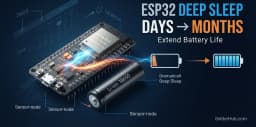
ESP32 Deep Sleep Guide: Extend Battery Life from Days to Months
ESP32 draws 240mA at full power — enough to drain an 18650 battery in 18 hours. With deep sleep, that same battery lasts 4 months. This guide covers all five wakeup sources, RTC memory, and real code you can drop into your next project.
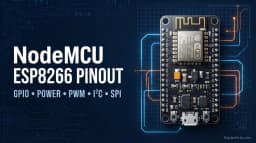
NodeMCU ESP8266 complete Pinout Guide: GPIO Numbers, D-Pins & Boot Pins Explained
Never confuse D1 with GPIO5 again — plus the D3/D4/D8 boot-mode pins that quietly stop your board from starting.