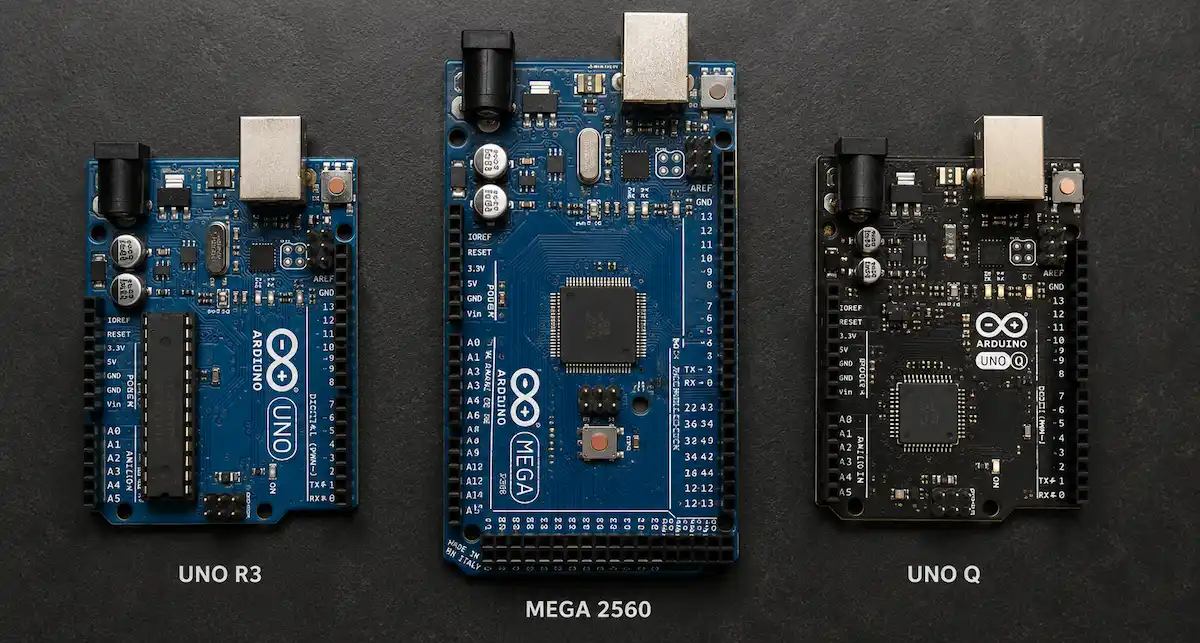
A common support pattern looks like this: a project needs to read three sensors, run a PID control loop, and push data out over SPI, all at a consistent 1kHz, and an Arduino Uno can't hold the timing. The fix usually isn't code optimization — it's that the Uno is the wrong chip for that specific job, which is a normal thing to run into rather than a sign of anything done wrong.
That's the core of this comparison. Arduino and STM32 rarely compete for the same job — they solve different problems that look similar from a first glance at a spec sheet. This is a direct breakdown of where each one actually wins.
The One-Line Version
Arduino (Uno/Mega/Nano) is a 5V, 8-bit AVR platform built around being difficult to get permanently stuck on — a large community, an extensive tutorial base, mature tooling, and genuinely forgiving hardware. STM32 is a 3.3V, 32-bit ARM Cortex-M platform offering substantially more processing power, more peripherals, and real low-power modes, in exchange for more setup friction on day one and considerably less tolerance for wiring mistakes.
<!-- IMAGE PLACEHOLDER: Arduino Uno and STM32 Blue Pill side by side on a desk for scale comparison -->For a first project, Arduino is almost always the right starting point. For a project that has already hit a real limitation on an existing Arduino build, the comparison below is worth reading through before deciding on a direction.
Specifications, Side by Side
| Arduino Uno R3 | Arduino Mega 2560 | STM32 Blue Pill (F103C8T6) | |
|---|---|---|---|
| Architecture | 8-bit AVR | 8-bit AVR | 32-bit ARM Cortex-M3 |
| Clock speed | 16 MHz | 16 MHz | 72 MHz |
| Flash | 32 KB | 256 KB | 64 KB |
| RAM | 2 KB | 8 KB | 20 KB |
| Logic level | 5V | 5V | 3.3V |
| Digital I/O | 14 | 54 | ~37 |
| Analog inputs (ADC) | 6 (10-bit) | 16 (10-bit) | 10 (12-bit, shared) |
| UART | 1 | 4 | 3 |
| SPI | 1 | 1 | 2 |
| I2C | 1 | 1 | 2 |
| USB | Programming only (via separate chip) | Programming only | Native USB peripheral |
| Price | ~$4-8 (clones) | ~$8-15 (clones) | ~$2-4 |
The clock speed and bit-width figures understate the actual gap. A 72MHz 32-bit core doesn't simply run proportionally faster than a 16MHz 8-bit core — 32-bit arithmetic that requires multiple instruction cycles on an 8-bit AVR (multiplying two 32-bit integers, for instance) completes in a single cycle on the Cortex-M3. For anything math-heavy — filtering sensor noise, running a PID loop, any form of signal processing — the STM32 isn't marginally faster, it's operating in a different capability tier entirely.
Notably, the Blue Pill is less expensive than an Arduino Uno clone while exceeding it on nearly every relevant specification. That comparison surprises most people the first time they see it laid out directly.
Where Arduino Wins
The learning curve is real, and it matters. Arduino's ecosystem — IDE, board manager, library manager, Serial.println() debugging — is purpose-built to take someone from "no microcontroller experience" to a working blink sketch within minutes, and to a working sensor read within an hour. STM32 can do the same, but first-time setup (installing the STM32duino core, ST-Link driver installation on Windows, understanding BOOT0 jumpers) introduces genuine friction that Arduino simply doesn't carry.
5V logic is more forgiving. A large share of hobbyist sensors, modules, and breakout boards default to 5V logic, a direct consequence of Arduino's decade-plus dominance as the default beginner platform. A 5V sensor wired directly to an Arduino works without complication. That same sensor wired directly to an unprotected STM32 GPIO risks damaging the chip. This single difference accounts for more STM32 onboarding friction than any other factor.
The community and tutorial base is larger and more mature. A bug encountered on an Arduino Uno very likely has a documented fix from years of accumulated community troubleshooting. STM32's community is substantial and growing, but smaller, more fragmented across HAL, LL, and Arduino-core approaches, and skews toward users with some existing embedded background.
The shield ecosystem is a genuine convenience. Arduino's shield ecosystem — motor drivers, displays, GPS modules, all designed to stack directly onto the header pins — has no direct equivalent on most STM32 boards. STM32 can connect to any of the same breakout boards, but the wiring is manual rather than a direct stack.
Where STM32 Wins
Raw performance, where it matters. Real-time signal processing, multiple simultaneous fast communication buses, or math the AVR core genuinely struggles with — STM32 isn't simply an improvement here, it's frequently the difference between a design working at all and not. A control loop requiring a consistent 1kHz update rate while also servicing an interrupt and reading an ADC is precisely the scenario where an Uno struggles and a Blue Pill has substantial headroom.
Real low-power modes. This is the point that surprises the most people. STM32's Stop and Standby modes reach single-digit microamps of draw with proper design — genuinely competitive with, and in some respects more granular than, the low-power capability commonly associated with the ESP32. Arduino's AVR chips have sleep modes as well, but they're less sophisticated, and the broader ecosystem around most Arduino boards (external USB-to-serial chips, power LEDs) reduces any savings gained at the chip level.
More peripherals, available simultaneously. Two I2C buses, two SPI buses, three USARTs, native USB, all on a $2-3 chip. A design that needs to read an I2C sensor, log to an SD card over SPI, and stream data over USB simultaneously does so without bit-banging or a second board.
12-bit ADC versus 10-bit. Four times the resolution on analog reads, which is directly relevant for measuring small voltage changes — precision sensor work, audio-adjacent projects, anything where quantization noise on a 10-bit ADC shows up in the results.
Clean scaling. The same core concepts, HAL, and debugging tools carry from a $2 Blue Pill through STM32's Nucleo boards, up to genuinely production-grade industrial parts. Arduino's AVR line has a lower ceiling — the Mega 2560 approaches the practical limit of 8-bit AVR, and further scaling typically means a platform change entirely, often to STM32, ESP32, or a similar 32-bit ARM part regardless.
The Code Itself: How Different Is It, Really?
Using the STM32duino core (the Arduino-compatible layer for STM32), day-to-day code closely resembles standard Arduino code — deliberately, to reduce the platform-switching barrier.
Blinking an LED, Arduino:
void setup() {
pinMode(LED_BUILTIN, OUTPUT);
}
void loop() {
digitalWrite(LED_BUILTIN, HIGH);
delay(500);
digitalWrite(LED_BUILTIN, LOW);
delay(500);
}
```
**Blinking an LED, STM32 (via STM32duino core):**
```cpp
#define LED_PIN PC13
void setup() {
pinMode(LED_PIN, OUTPUT);
}
void loop() {
digitalWrite(LED_PIN, LOW); // Active LOW on Blue Pill
delay(500);
digitalWrite(LED_PIN, HIGH);
delay(500);
}
```
Nearly identical, aside from the pin naming convention (`PC13` rather than a board-defined constant) and the inverted LED logic specific to the Blue Pill. `analogRead()`, `Serial.begin()`, `Wire.begin()` — the familiar Arduino API — mostly carries over directly to STM32 through this core.
The genuine divergence appears when dropping to STM32's native **HAL** (Hardware Abstraction Layer) or CubeMX-generated code, which exposes far more direct control over clocks, DMA, and peripheral configuration than Arduino's simplified API — at the cost of requiring familiarity with concepts Arduino deliberately abstracts away. Most hobbyist STM32 projects never require this layer. It becomes necessary specifically when a design needs something the Arduino-style API doesn't expose — precise timer configuration, DMA transfers, or the lowest achievable power draw.
---
## A Concrete Example: Where the Uno Runs Out of Headroom
The scenario referenced at the start — three sensors, a PID loop, SPI output, all at 1kHz — illustrates the gap directly.
<!-- IMAGE PLACEHOLDER: Timing diagram comparing Arduino Uno vs STM32 handling the same sensor-read-and-control loop -->
On an Uno, reading three analog sensors (roughly 100 microseconds each with stock AVR ADC settings), running nontrivial PID math in floating point (AVR has no hardware floating-point unit — every float operation is emulated in software, and emulation is slow), and pushing results out over SPI while holding a consistent 1ms loop period is genuinely tight. It's achievable, but it requires fighting the chip's limitations throughout, often through fixed-point math specifically to avoid the floating-point penalty.
On a Blue Pill, the same three ADC reads complete faster (STM32's ADC converts more quickly per channel and can read multiple channels via DMA with no CPU involvement at all), the Cortex-M3 handles floating-point math far faster than AVR's software emulation, and SPI runs at a substantially higher clock rate where throughput demands it. The same loop that was tight on the Uno has real margin on the Blue Pill.
This pattern recurs across nearly every case where an Arduino "can't quite keep up" — it's rarely that Arduino is incapable in an absolute sense, more that the entire optimization budget is being spent reaching a target the STM32 clears without effort.
---
## Where the ESP32 Fits
A comparison between STM32 and Arduino usually has the ESP32 somewhere in the background, so it's worth addressing directly. **ESP32 adds Wi-Fi and Bluetooth that neither Arduino nor STM32 carries in its base form** — where a project requires wireless connectivity, that requirement typically decides the platform on its own, independent of any performance comparison between STM32 and Arduino. Where a project is wired, sensor-heavy, or timing-critical without a networking requirement, STM32 generally outperforms the ESP32 on real-time determinism and peripheral count, while drawing less current in its low-power modes for equivalent tasks. The practical framing: three tools with genuine specialization — Arduino for approachability, STM32 for wired performance and peripheral density, ESP32 for anything requiring network connectivity.
---
## The Decision
**Choose Arduino** for a first microcontroller project, for teaching, for projects squarely within simple sensor-read-and-respond territory, or where a shield/breakout ecosystem built around 5V logic and Arduino's header layout is already a factor.
**Choose STM32** where a genuine performance ceiling has already been hit on Arduino (timing, math, simultaneous peripherals), where low power draw matters for a battery project without the overhead of Wi-Fi/Bluetooth that isn't needed, or where 32-bit ARM development experience is a deliberate goal ahead of more advanced embedded work.
**Choose neither, and use an ESP32 instead**, where wireless connectivity is a requirement at all — that single factor typically overrides every other consideration in this comparison.
Treating this as a permanent commitment to one platform isn't the practical reality for most teams working across enough projects — the common pattern is having all three available and reaching for whichever one actually fits the specific job.
---
## Summary
Arduino and STM32 aren't really competitors — they're tools calibrated for different amounts of friction and different performance ceilings. Arduino trades some raw capability for a close to frictionless first experience. STM32 asks for more patience upfront — 3.3V logic discipline, a marginally steeper toolchain setup — and returns that investment with real headroom once a project exceeds a basic sensor-and-blink loop.
The practical test: has the current Arduino-based design hit a limitation that persists regardless of code optimization? If so, that's a clear signal to move to STM32. If not, Arduino remains the right tool until that limitation actually appears.
---
## What to Read Next
- [STM32 Blue Pill Pinout: Every GPIO, ADC, and Alternate Function Explained](/articles/stm32-blue-pill-pinout-guide) — the starting reference once a move to STM32 is decided
- [STM32 Low-Power Modes: Sleep, Stop, and Standby Explained](/articles/stm32-low-power-modes-sleep-stop-standby) — for teams evaluating STM32 specifically for a battery project
- [Arduino Mega vs Uno: Which One Do You Actually Need?](/articles/arduino-mega-vs-uno-comparison) — for teams staying within the Arduino ecosystem but needing more I/O
- [ESP32 vs Arduino: Which Should You Choose in 2026?](/articles/esp32-vs-arduino-which-should-you-choose-in-2026) — where wireless connectivity is part of the decision
---
*SolderHub — Build. Simulate. Learn.*